Kun.uz has reviewed the court verdict.
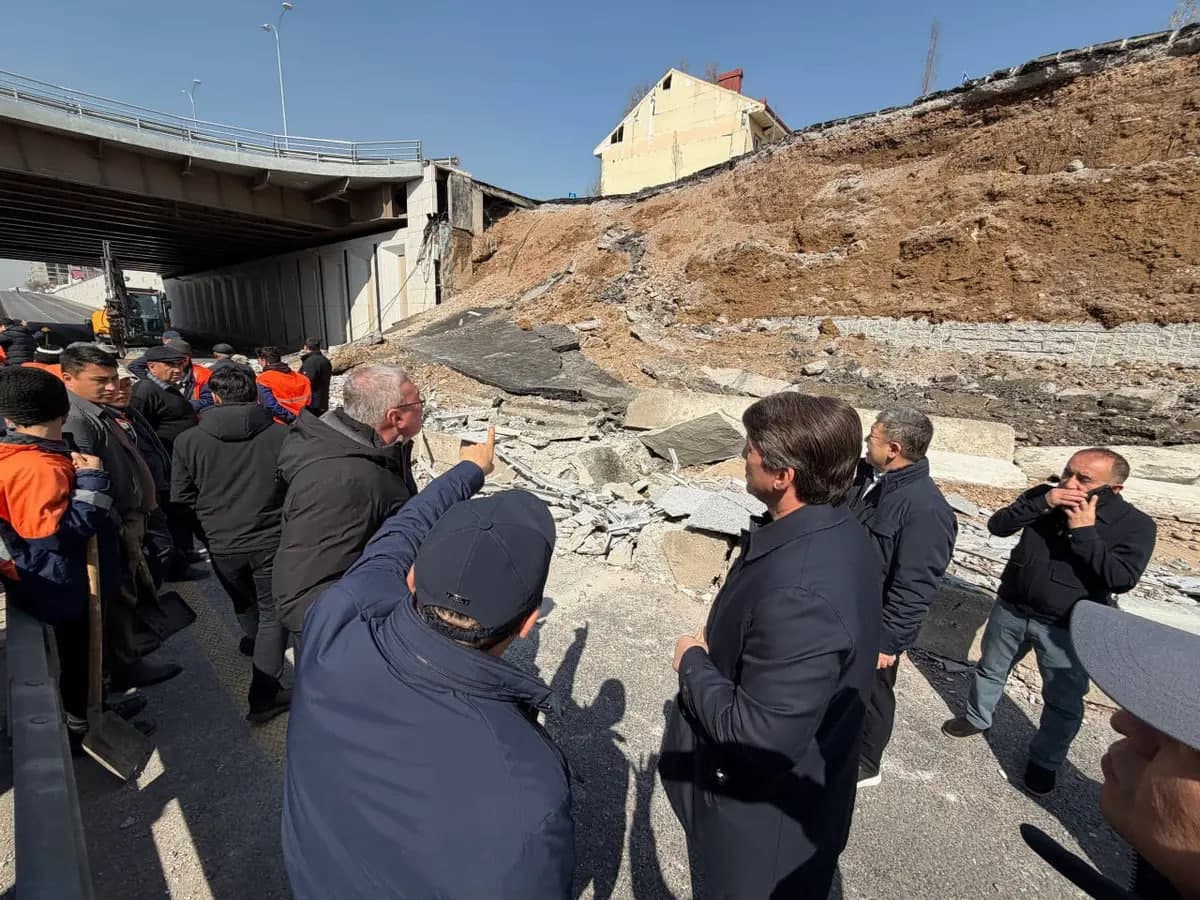
The case concerns the collapse of part of the overpass at the intersection of Temur Malik and Buyuk Ipak Yuli streets, which occurred on March 12, 2026. According to the verdict, construction defects worth UZS 6.177 billion were identified at the site, while work valued at almost UZS 1.2 billion was included in completion documents despite never having been carried out.
Officials, engineers and contractor among those convicted
The six defendants were:
- Akmal Murodov, deputy director for general affairs at the Tashkent region branch of the state institution UzYolkoprik Cluster;
- Sanjar Mannonov, deputy director and chief engineer of the Directorate for the Construction and Reconstruction of Public Roads;
- Zafar Shorakhmedov, chief specialist of the engineering supervision and work acceptance department at the same directorate;
- Abdumutal Isropilov, site manager at the Tashkent region branch of UzYo'lkoprik Cluster;
- Nurshod Mavlonov, chief project engineer of the artificial structures design department at Yol Loyiha Byurosi LLC;
- Obid Adilov, director of Grand Nur Yol Qurilish LLC.
All six were initially placed under preventive measures involving bail. Earlier detention orders for two defendants and house arrest imposed on another were later replaced with bail.
Court details procurement and construction violations
According to the verdict, a Cabinet of Ministers resolution adopted on March 24, 2022, approved the reconstruction of a section of the Tashkent Ring Road passing through Temur Malik Street, including the construction of a new overpass.
In January 2024, the Tashkent region branch of UzYolkoprik Cluster and the Directorate for the Construction and Reconstruction of Public Roads signed a first-stage construction contract worth UZS 118.996 billion. Additional agreements concluded in August 2024 increased the contract value by UZS 94.015 billion.
The court found that construction defects worth UZS 6.177 billion affected the foundations, retaining walls, earthworks, backfilling, upper base layers and exterior finishing of four monolithic concrete retaining walls.
It also established that work involving basalt geogrid installation valued at UZS 433 million and the laying of a sand-and-gravel mixture worth UZS 766 million had been entered into official completion certificates despite never being performed.
According to the verdict, the defendants acted in collusion to embezzle a total of UZS 7.377 billion in budget funds. The court concluded that these violations ultimately led to the collapse of part of the retaining wall supporting the overpass on March 12.
Most defendants rejected the charges
Five of the six defendants pleaded not guilty.
Akmal Murodov argued that the prosecution had failed to prove that the alleged embezzlement of UZS 7.377 billion had caused the retaining wall to collapse.
He maintained that investigators had wrongly classified UZS 6.177 billion worth of construction work as defective, arguing instead that the issues amounted to quality deficiencies that could have been corrected under the terms of the contract.
Murodov also stated that reconstruction work on the 34–36 km section of the Tashkent Ring Road had been completed by September 1, 2024, while the project documentation prepared at that time did not include basalt geogrid or sand-and-gravel installation. According to his testimony, those items were added only in supplementary cost estimates prepared in July 2025, making it impossible to complete work that had not yet been included in the approved project documentation.
The remaining four defendants also denied wrongdoing, offering similar arguments.
Only Abdumutal Isropilov partially admitted guilt. He testified that construction had initially begun before project and cost documentation had been finalized and confirmed that the disputed works were introduced only in the supplementary estimates prepared in July 2025.
Experts identified multiple structural failures
Following an order from the Transport Prosecutor's Office, experts from the Republican Center for Forensic Expertise, together with specialists from several relevant organizations, examined the site.
According to the verdict, the investigation identified a series of serious construction deficiencies that directly contributed to the collapse.
Among them were insufficient anchoring of reinforcement bars in the third retaining wall, where the embedded length measured only 400–450 mm instead of the 750 mm required by the design; incorrectly spaced transverse reinforcement; an excessively thick protective concrete layer; horizontal cold joints in sections where the wall thickness changed, with the upper portion collapsing along those joints; and improperly positioned concrete joints that failed to ensure the required structural strength.
The experts concluded that the collapse would not have occurred had the retaining wall been constructed in full compliance with building codes, regulations and other applicable technical standards.
Fines imposed, budget funds confiscated
The Mirzo Ulugbek District Criminal Cout found all six defendants guilty of official forgery and embezzlement under the Criminal Code.
Each was banned from holding managerial or public office for one year and fined UZS 116.2 million, except for one defendant, who was fined UZS 112.5 million.
The court also ordered that the UZS 7.377 billion deposited into the General Prosecutor's Office account be transferred to the state budget.
The parties were informed of their right to appeal the verdict.
Background
On March 12, 2026, part of the access road leading to the Buyuk Turon Bridge in Mirzo Ulugbek district collapsed.
Images shared on social media showed that the collapse occurred on the section of the overpass connecting Temur Malik Street with Buyuk Ipak Yuli Street.
The Buyuk Turon Bridge, also known as the Troitsky Bridge, was reconstructed as part of the Temur Malik Street redevelopment project at a cost of UZS 128.6 billion. It was opened to traffic in August 2024, ahead of Uzbekistan's Independence Day celebrations.
No one was injured in the incident. Emergency services, technical experts and representatives of relevant authorities were dispatched to the scene, and the affected area was immediately cordoned off.
Video footage of the retaining wall collapsing emerged shortly afterwards, prompting the opening of a criminal investigation.