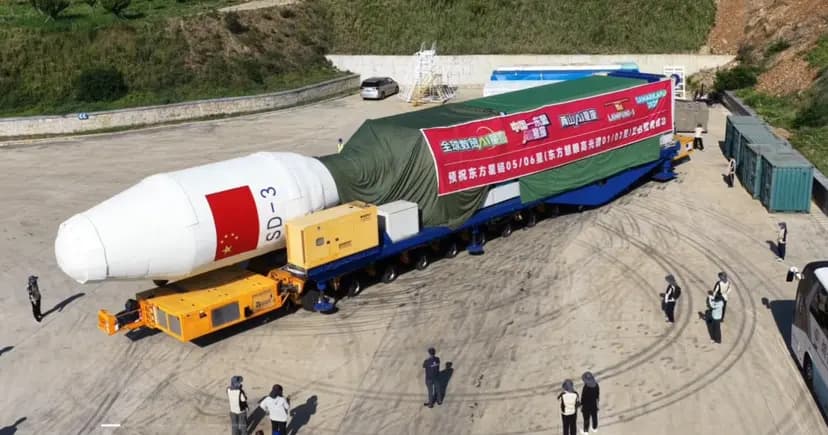
The launch will be carried out by the Chinese company STAR.VISION and will also place the Lampung-1 hyperspectral satellite into orbit.
The Samarkand-2028 mission is the result of cooperation between the Uzbekkosmos Agency and STAR.VISION under a strategic memorandum signed by the two sides.
The satellite was named Samarkand-2028 to commemorate the decision to host the 2028 International Astronautical Congress in Samarkand. The name was chosen in honor of the decision adopted during the International Astronautical Congress held in Sydney, Australia.
As part of the project, specialists from the Uzbekkosmos Agency developed a dedicated artificial intelligence module for the satellite's onboard systems. The technology will enable hyperspectral data to be processed directly in orbit, significantly improving the efficiency of Earth observation.
The data collected by the satellite is expected to support a wide range of applications, including agriculture, environmental protection, natural resource monitoring, and other remote sensing activities.